Organ Recitals
During Michaelmas Term 2026, organ and other recitals will take place on Mondays at 20:30 (term-time only) and last for about 35 minutes.
Entry is free via Holywell Street and the recitals are livestreamed on YouTube: please click here to view.
The Michaelmas Term season features distinguished visiting musicians as well as New College's organists and organ scholars.
The last of this term’s Recitals is on Thursday 18 June at 1.15pm and will be given by:
Hugh Rowlands Assistant Organist, New College
Programme
Prelude and Fugue in G major BWV 541 J. S. Bach (1685–1750)
Dissolution Thomas Metcalf (b. 1996)
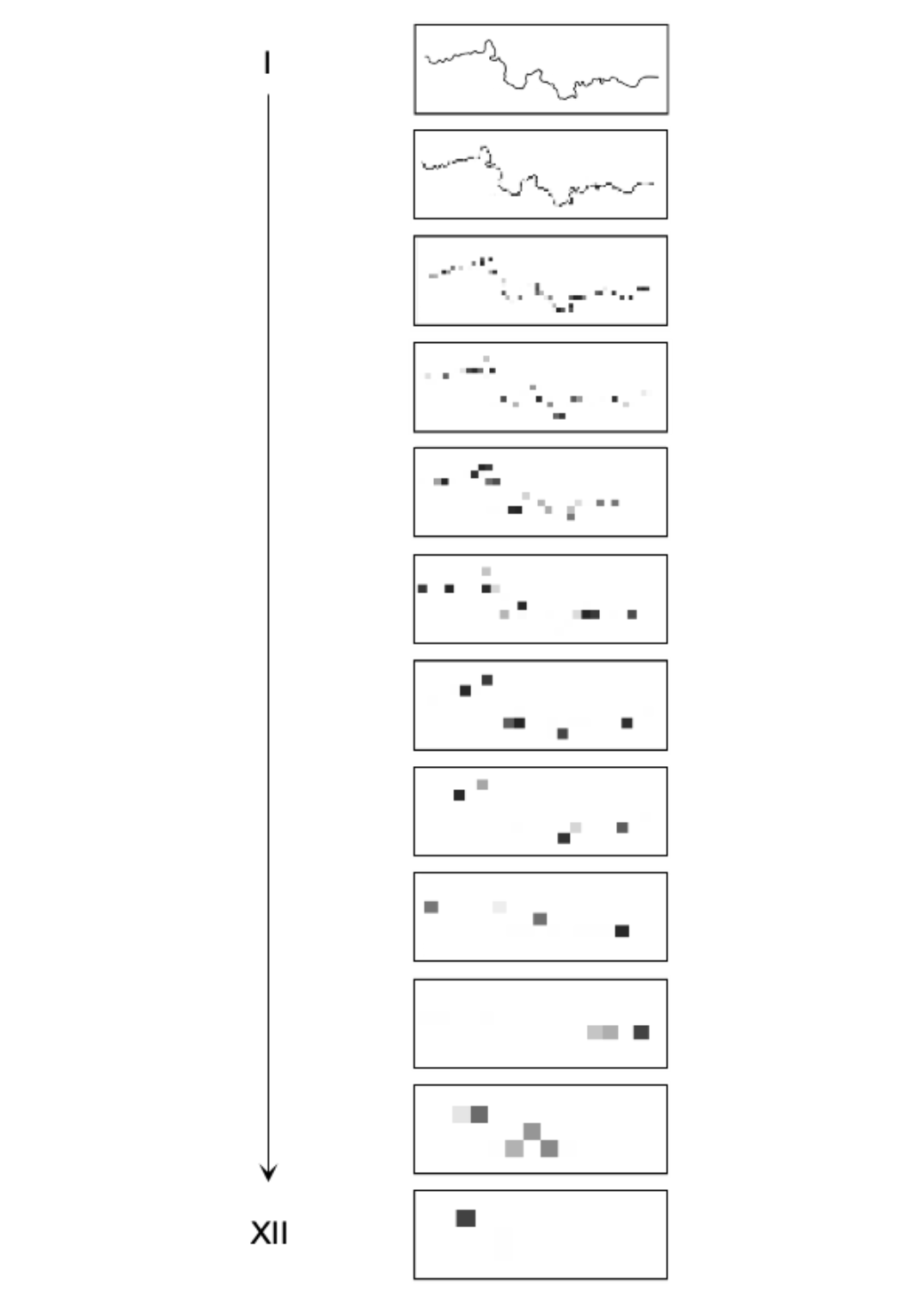
DISSOLUTION (2020) explores how an image sounds as it becomes increasingly pixelated. The starting point is a line taken from a map of the River Thames from which I derived twelve pitches, taking points along the river and measuring these in a graphical space where higher positions correspond to higher pitches and lower positions to lower pitches. Across twelve movements, organised in three parts, I took the original image and increasingly pixelated it such that, by the end, there was only a single large pixel. The music also participates in the same pixelation process, and from movement to movement I had fewer pitches to choose from and they become more dissonant–a result of the averaging process, mirroring the visual pixelation process. The music follows a trajectory of failure and loss as it increasingly struggles to make sense of the pixelated image until, in the final movement, the only sound played is a single cluster chord, notated as a timbral graphic score that eschews standard notation altogether.
This was the first of my pieces to explore the idea of failure as process; an aspect now present in almost all of my music.
Part One (I–III) | Representation: The image is clear; its music is detailed and orderly.
Part Two (IV–VIII) | Pixelation: The image is pixelated; its music begins to rely on its own failed representation and empty spaces. The final chord of VIII marks the beginning of the end.
Part Three (IX–XII) | Obliteration: The image no longer exists; its music becomes filled with glitches as total failure becomes inevitable.
Biography
Hugh Rowlands is Assistant Organist at New College, Oxford. Previously he has been Assistant Master of Music at the Chapels Royal, HM Tower of London, and Acting Director of Music at Sidney Sussex College, Cambridge University.
As a soloist, he has given recitals at major venues in the UK, including Westminster Abbey, Westminster Cathedral, and the St Albans International Organ Festival. Hugh has worked with a broad range of leading groups and performers, appearing across the UK and internationally, including at the Barbican Centre, the Paris Philharmonie, Shanghai Symphony Hall, and the National Centre for Performing Arts, Beijing. Recent engagements include collaborations with the Grange Festival Opera, English Chamber Orchestra, Alamire, London Choral Sinfonia, the London Contemporary Orchestra, and Icelandic duo, Jònsi and Alex. As a pianist, he has worked with Roderick Williams, Graham Johnson and Iain Burnside. He has recorded on the SOMM and Albion labels, and performed on BBC Radio 3. In 2024, he made his first solo recording of the Klais organ at Haileybury, as well as a CD of choral music with Haileybury Chamber Choir. A regular member of the James McVinnie ensemble, he has performed at the Barbican Centre, Saffron Hall, Bold Tendencies, and the Southbank Centre.
Hugh is a graduate of the University of Cambridge, Guildhall School of Music and Drama, and is a Fellow of the Royal College of Organists. He has held organ scholarships at Sidney Sussex College, Cambridge, King’s Voices, King’s College, and the Royal Hospital Chelsea. From 2021–2024, he was Deputy Director of Music at Haileybury College.